

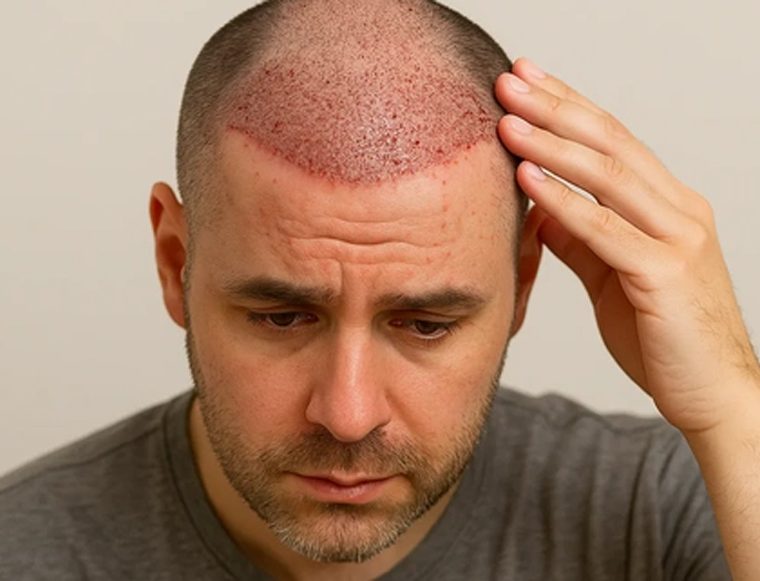
For many people struggling with hair loss, a hair transplant is the most permanent and effective way to regain the self-confidence lost over the years. However, unfortunately, not every operation results in the dreamed-of full and natural-looking hair. Choosing the wrong clinic, inexperienced hands, sloppy planning mistakes, or falling victim to unregulated, “black market” centers… Whatever the reason, looking in the mirror after a process that ends in frustration is psychologically exhausting. Exactly at this point, we can almost hear you asking that big, anxious question: “Can a failed hair transplant be fixed? Or do I have to live with this artificial look for the rest of my life?”
Take a deep breath and put your mind at ease. Our answer is a resounding yes; a bad hair transplant can be corrected. Thanks to these delicate procedures, known in medical literature as “hair transplant revision” or “hair transplant corrective surgery,” it is entirely possible to leave that bad past experience behind and achieve the natural hair you have always deserved. As Zeynep Metin Hair Transplant Clinic, we have compiled the details of how revision processes work in light of current online data and our clinical expertise.
Why Do Hair Transplants Fail?
Before moving on to the hair transplant correction phase, it is vital to accurately analyze the source of the current problem. Failed hair transplant cases frequently encountered by experts generally involve one or more of the following fundamental mistakes:
The “Pluggy” Look and Incorrect Angling: If the hair follicles (grafts) are not implanted according to their natural growth direction, angle, and skin structure, the hair will grow straight up from the scalp in a very harsh, unnatural manner. This “doll’s hair” or “pluggy” look is the leading cause for revision requests.
Unnatural Hairline: A frontal hairline that does not suit the person’s facial anatomy, does not reflect their age, is placed too far back or too close to the forehead, and looks as if drawn with a ruler instantly reveals that the procedure is far from aesthetic.
Insufficient Density: Failing to achieve the expected fullness because a large portion of the implanted grafts lose their vitality during the process, or because not enough grafts were used to cover the targeted area.
Depletion of the Donor Area: Harvesting grafts from the nape area disproportionately, unevenly, and in excessive amounts (over-harvesting) leads to permanent bald spots and a patchy, moth-eaten appearance at the back of the head.
Old-Style Scars (Scar Tissue): Distinct horizontal scars left over from transplants performed with the previously popular FUT technique constitute a serious aesthetic problem that prevents patients from wearing their hair short.
How is a Hair Transplant Revision Planned? Procedure Steps
To be frank, a hair transplant revision requires much more mastery, fine craftsmanship, technical knowledge, and experience than a standard first-time operation. Because the surgeon is no longer faced with a “blank, clean canvas,” but a “flawed painting” that needs careful restoration.
The hair transplant correction process we carry out at Zeynep Metin Hair Transplant Clinic generally proceeds as follows:
1. Precise Evaluation of Current Donor Capacity: The most critical and limiting factor determining success in hair transplant revisions is whether you have enough high-quality hair follicles left in your donor area at the nape of the neck (or alternative donor areas like the beard and chest, if the nape is insufficient). Our expert team first measures this capacity with millimeter precision and presents you with the most honest picture.
2. Extraction of Faulty Grafts and Camouflage Techniques: If there are glaring, thick-ended, and incorrectly angled grafts on your front hairline, it may be necessary to extract these faulty grafts one by one using a micromotor before planning a new transplant. These extracted follicles are never wasted; they are re-implanted at correct angles in the crown or mid-scalp regions. In cases where extraction is not necessary, a successful “camouflage” is achieved by densely implanting finer, single grafts around the flawed area using FUE or DHI techniques.
3. Covering Scars (Scar Revision): If there are scars left from previous botched operations, an attempt is made to eliminate the visibility of the scar by transplanting over this tissue with special surgical precision. It should not be forgotten that capillary blood circulation in scar tissue is weaker compared to healthy skin. Therefore, the nourishment and survival rate of the implanted follicles might be slightly lower than normal; it is important to proceed with realistic expectations during this process.
The Golden Keys to Success in Revision Operations
If you have rolled up your sleeves for a hair transplant revision, you must act much more selectively and consciously to avoid experiencing the same frustration once again.
The first rule is timing. At least 10 to 12 months must have passed since the first flawed procedure. This waiting period is an inflexible necessity for the trauma beneath your scalp to heal completely, for the existing transplanted hair to complete its final cycle, and for the tissue to become ready to be operated on again.
The second golden rule is managing expectations correctly. The primary goal in revision surgery is not to seek the perfection of a completely untouched scalp, but to elevate the current bad situation to the most natural and aesthetically satisfying level that will make you make peace with the mirrors. In advanced cases, the procedure may need to be performed in two consecutive sessions (with a touch-up plan) to ensure both the healing of the scar tissue and the achievement of the targeted density.
We Stand By You as Zeynep Metin Hair Transplant Clinic
After a failed and exhausting experience, trusting again, feeling hopeful, and lying on that operating table once more is not an easy psychological decision. We understand you. Therefore, as Zeynep Metin Hair Transplant Clinic, we offer our revision patients not just a medical correction procedure, but an end-to-end transparent, honest companionship that is completely sensitive to the patient’s psychology.
If the botched hair transplant you had previously makes you unhappy and prevents you from going outside without a hat, you do not have to endure this situation. With a detailed hair analysis, accurate measurements, and a personalized professional revision plan, we can erase that artificial and disturbing look from your hair. We are here to offer you the most natural solution by blending the latest FUE and DHI methods with our high medical standards.
