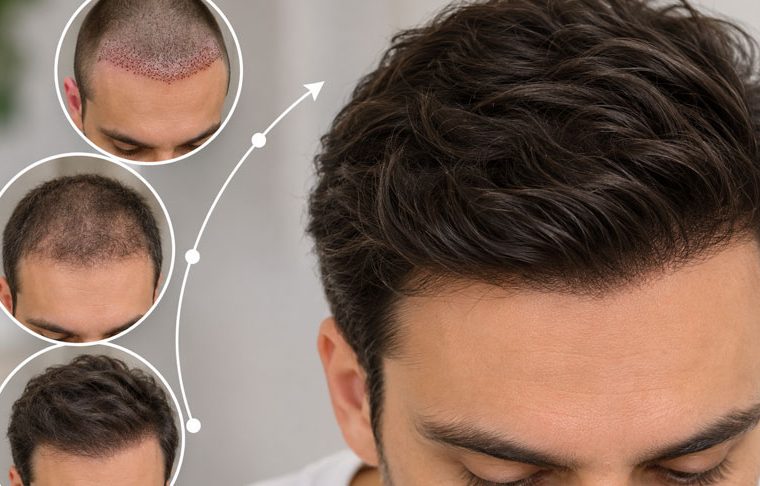
Nine months after a hair transplant is an exciting stage because the result is usually much easier to see than it was during the early months. The transplanted hairs have had time to grow, many strands have become longer and thicker, and the overall coverage can look noticeably different compared with the first few months. However, the nine-month point should not always be considered the final result. Hair follicles do not all begin growing at exactly the same time, and some transplanted hairs may still be developing in thickness, length and texture. For many patients, nine months provides a good indication of the direction of the result, while further improvement can continue during the following months.
What Should Hair Look Like 9 Months After a Hair Transplant?
By nine months, many transplanted hairs are usually visible and have gained enough length to blend more naturally with the surrounding hair. The dramatic shedding phase that commonly occurs during the first weeks is normally well behind the patient at this stage. New growth that began several months earlier has had time to become longer and more noticeable. The hairline may look more established, and previously thin areas can have greater coverage. Patients who received grafts in the frontal area may notice that the overall shape of the hairline is now much easier to appreciate. The transplanted hairs may also feel stronger than they did during the early growth period. New hairs can initially emerge thin and soft, but they may gradually become more similar in appearance to the donor hair. Most patients begin seeing their results between six and nine months, although some require around 12 months.
How Much Density Should You Have at 9 Months?
There is no single level of density that every patient should have at nine months. The visible result depends on the number of grafts transplanted, the size of the recipient area, hair thickness, hair texture, donor quality and how the grafts were distributed. A patient with thick or curly hair may appear to have stronger visual coverage than someone with very fine, straight hair, even if a similar number of grafts were transplanted. The location of the transplant also matters. Frontal hairline growth can sometimes become visually noticeable earlier, while areas such as the crown may appear to develop more slowly. Density should therefore be judged according to the individual treatment plan rather than by comparing one patient’s nine-month photographs with another person’s result. A well-planned **Hair Transplant** aims to create appropriate visual coverage while also preserving the donor area for the long term.
Can Hair Still Become Thicker After 9 Months?
Yes. The appearance of transplanted hair can continue to change after the ninth month. Some hairs that have already emerged may continue to increase in diameter and length. Other follicles may enter their visible growth phase later than neighbouring follicles. This means the transplanted area can gradually look fuller even without a sudden appearance of large numbers of new hairs. Hair texture can also continue to settle. Early transplanted hairs may sometimes look fine, uneven or slightly different from the surrounding hair. As growth progresses, they can become easier to style and blend more naturally. The final appearance is therefore influenced not only by how many hairs are visible but also by how mature those hairs have become. ISHRS material notes that the process of healing and maturation after transplantation can continue for approximately 12–15 months.
Is 9 Months the Final Hair Transplant Result?
Not necessarily. Nine months can show a substantial part of the result, but continued development during months 10, 11 and 12 is common. Some patients may also notice further maturation beyond one year. The timeline varies because transplanted follicles follow individual growth cycles. They do not all shed, rest and restart growth at exactly the same time. Hair characteristics can also influence how quickly the result appears complete. Fine hair may need more time and length before it provides strong visual coverage, while thicker or curlier hair can sometimes create the appearance of density sooner. The crown can also require additional patience because its larger surface area and circular growth pattern can make changes appear more gradual. For this reason, judging a transplant too early can give an incomplete picture of the eventual result.
What If Hair Growth Still Looks Thin at 9 Months?
Seeing less density than expected at nine months does not automatically mean that the transplant has failed. Some patients simply develop more slowly, and additional thickening or growth may still occur during the following months. It is also important to distinguish transplanted hair from surrounding natural hair. Hair transplantation relocates selected follicles, but it does not automatically prevent existing non-transplanted hair from continuing to thin. The size of the original treatment area should also be considered. When a limited donor supply has been distributed across a large area, the final appearance may naturally be different from a smaller, more concentrated transplant. If growth appears significantly different from the expected recovery plan, the appropriate approach is to assess the donor area, recipient area, hair growth pattern and progression over time rather than judging the result based on a single photograph or month. The American Academy of Dermatology notes that while many patients see results between six and nine months, some require approximately 12 months.
Frequently Asked Questions About 9 Months After a Hair Transplant
Is 9 Months Enough to See Hair Transplant Results?
For many patients, nine months is enough to see a significant change in hair growth and coverage. However, the result can continue developing for several more months.
Will My Hair Get Denser After 9 Months?
It can. Existing transplanted hairs may continue to become thicker and longer, while some follicles may enter visible growth later than others.
Is the Hairline Final at 9 Months?
The shape of the transplanted hairline is usually much easier to see by nine months, but the hairs can continue to mature and become thicker afterward.
Why Does My Hair Still Look Thin at 9 Months?
Hair thickness, graft number, recipient-area size, natural hair loss and individual growth speed can all affect visual density. Some patients also mature more slowly than others.
Can New Hair Still Grow After 9 Months?
Yes. Growth and maturation can continue after nine months because individual follicles do not all follow exactly the same growth schedule.
Does the Crown Take Longer to Grow After a Hair Transplant?
The crown can sometimes appear slower to develop because it covers a larger area and has a circular growth pattern. Patients may therefore need additional time before judging crown density.
Can Transplanted Hair Still Be Thin at 9 Months?
Yes. Some transplanted hairs may still be finer than their eventual appearance. Hair calibre and texture can continue changing as the result matures.
Should I Compare My 9-Month Result With Other Patients?
Direct comparisons can be misleading because graft numbers, donor density, hair thickness, curl pattern, treatment area and natural hair loss vary considerably between patients.
When Is the Final Hair Transplant Result Usually Seen?
Many patients see substantial results within six to twelve months, while further maturation may continue for around 12–15 months in some cases.
Can Natural Hair Continue to Thin After a Hair Transplant?
Yes. A hair transplant moves selected donor follicles but does not automatically stop future thinning of the surrounding natural hair. Long-term hair loss should therefore be considered when evaluating density.